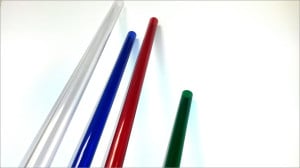


PVC Tubes or PP Tubes? Which performance for which application?
In many industrial sectors — from construction to food processing, as well as transport, chemicals and logistics — plastic tubes play a key functional role. Among the most commonly used materials, PVC (Polyvinyl Chloride) and PP (Polypropylene) stand out as leading solutions, each offering distinct technical advantages. Mechanical strength, chemical resistance, weight, cost, thermal behaviour, ease of processing: the choice between a PVC tube and a PP tube depends directly on the application’s technical constraints. Need advice? Contact our teams on +33 4 71 61 29 99 or via our online form.
Characteristics of PVC tubes
Rigid PVC is widely used for manufacturing plastic tubes intended for demanding industrial environments. It is valued for its strength, chemical resistance and dimensional stability.
Advantages of PVC tubes
- High mechanical strength: PVC offers excellent rigidity and compression resistance.
- Dimensional stability: it maintains its structural properties even when exposed to temperature variations.
- Good chemical resistance: withstands exposure to oils, solvents and common chemical agents.
- Durability: its long service life is a major advantage for industries requiring robust components.
- Compliance with industrial standards: suitable for sectors subject to strict regulations.
Applications of PVC tubes
- Construction industry: fluid transport, electrical cable protection.
- Agricultural sector: winding of agricultural films, irrigation conduits
- Textile & packaging: winding of films, adhesive tapes, plastic foils
- Chemical industry: pipework for corrosive products
Characteristics of PP tubes
Polypropylene (PP) is a thermoplastic known for its low density, flexibility and excellent chemical resistance. It is often used when specific mechanical behaviour is required.
Advantages of PP tubes
- Lightweight: lower density than PVC, improving handling and reducing overall system weight.
- Good thermal resistance: better tolerated exposure to high temperatures without degrading.
- Excellent chemical resistance: tolerates acids, bases and industrial solvents.
- Greater flexibility: unlike PVC, PP offers elasticity that reduces breakage under mechanical stress.
- Recyclability: fully recyclable — a key advantage for sustainability-focused applications
Applications of PP tubes
- Food industry: suitable for food contact, widely used for film production and packaging
- Medical sector: components requiring non-toxic materials and resistance to disinfectants
- Chemical industry: pipework exposed to corrosive products
- Automotive: protective sheaths for cables and fluid lines
Comparison and selection based on the application
Choosing between a PVC tube and a PP tube depends mainly on the operating environment and the technical constraints.
Which material for which need?
- Need high rigidity and mechanical strength? → PVC is more suitable
- Exposure to aggressive chemicals? → PP offers superior chemical resistance
- High temperatures? → PP withstands thermal variations better
- Need a lightweight solution? → PP is easier to handle
- Regulated environments (food, medical)? → PP is often more compliant
Why choose ABI Profils?
At ABI Profils, we master extrusion, co-extrusion and post-extrusion for PVC and PP tubes. Our versatile production capabilities allow us to:
- Adapt formulations to enhance UV, impact or thermal resistance
- Manufacture custom tubes: diameter, thickness, rigidity, flexibility, colour
- Integrate specific finishing options (cutting, drilling, marking, adhesive application)
- Meet regulatory requirements (food contact, REACH, RoHS, etc.)
Our solutions are used in construction, chemicals, medical industries, transport and many other sectors where the reliability of plastic tubes is essential.
Our teams are available to help you choose the material best suited to your project. Contact us on +33 4 71 61 29 99 or via our online form for a detailed study of your requirements.
FAQ – Frequently asked questions
PVC is recommended when high mechanical and chemical resistance is required. PP is preferred for its light weight and excellent resistance to high temperatures and aggressive chemical agents.
Yes, both materials are recyclable. PP is generally easier to recycle and retains its properties more effectively. PVC requires more specific recycling processes due to the additives it may contain.
- PVC tubes: plumbing infrastructure, electrical conduits, applications requiring rigidity
- PP tubes: environments with high thermal variations such as food or chemical industries
- PP has limited natural UV resistance but can be stabilised with additives.
- Rigid PVC offers better inherent UV resistance and is more suitable for outdoor use.
It depends on the operating conditions. PVC is known for its dimensional stability and weather resistance, often offering over 50 years of outdoor service life. PP is more sensitive to environmental conditions but remains a durable solution for many industrial uses.
Cet article vous a intéressé ? Partagez le :
Nos autres actus
17 September 2025
ABI Profils strengthens its international team with the arrival of Else CARDEN
At ABI Profils, our commitment to international development is a core element of our growth strategy. As part of this ambition, we are pleased to announce the arrival of Else Carden within our sales team. Her international experience will be a valuable asset in supporting ABI Profils’ expansion across Europe.

17 September 2025
PVC as a technical material: properties, advantages and industrial applications
PVC (Polyvinyl Chloride) is one of the most widely used thermoplastic polymers in the industrial world. Its versatility, durability and mechanical performance make it a key material for manufacturing technical tubes, profiles, mandrels and protective sheaths. Available in both rigid and flexible versions, PVC meets the requirements of various sectors such as construction, automotive, signage, packaging and medical.
15 September 2025
Rigid transparent plastic tubes: selection criteria for industrial use
Rigid transparent plastic tubes are essential in many industrial sectors. They are widely used in lighting systems, signage, medical applications or for design requirements. Their transparency combined with their mechanical resistance makes them indispensable components. But how do you select the right material? Which characteristics should be prioritised to ensure performance and durability in demanding environments?