

PVC as a technical material: properties, advantages and industrial applications
PVC (polyvinyl chloride) is one of the most widely used thermoplastic polymers in industry. Its versatility, durability and mechanical performance make it a key material for technical tubes, profiles, winding cores and protective sleeving. Available in rigid and flexible grades, PVC meets the requirements of many sectors, including construction, automotive, signage, packaging and medical. At ABI Profils, we have mastered PVC extrusion and make custom products to the most demanding specifications. Need advice? Call our team on +33 4 71 61 29 99 or use our online form.
PVC: a material with outstanding technical properties
PVC is a thermoplastic polymer whose widespread use is explained by its many technical qualities. It can be formulated as rigid or flexible, which makes it suitable for challenging environments. Here are its key properties:
1. Excellent mechanical strength
Rigid PVC is valued for its robustness and dimensional stability. It offers very good resistance to compression, a major advantage for applications such as cores for technical films or industrial tubes.
2. Resistance to chemicals and weathering
One of PVC’s major strengths is its ability to withstand chemicals, UV and harsh outdoor conditions. It retains its properties even after prolonged outdoor exposure.
3. Durability and cost-efficiency
PVC is easy to process and economical, with an ideal balance between performance and cost.
4. Outstanding insulation properties
PVC also provides excellent electrical and thermal insulation. It is therefore widely used in construction, electronics and lighting applications.
Rigid PVC and flexible PVC: two formulations, different uses
At ABI Profils, we work with several PVC formulations to meet specific industrial requirements.
- Rigid PVC: robust and stable, ideal for technical profiles, industrial cores and high-strength tubes.
- Flexible PVC: more elastic, used for plastic strips, protective sleeving and some medical components.
Main industrial applications of PVC
PVC is essential in many industrial sectors because of its versatility and resistance.
1. Building and construction
PVC is widely used in construction because of its weather resistance and insulation properties. Applications include sealing profiles, plumbing pipes, ventilation systems and architectural features.
2. Automotive and transport
In the automotive industry, rigid and flexible PVC is used for cable protection, seat coverings and interior trim. Its impact resistance and tolerance of temperature changes make it a reliable choice for this demanding sector.
3. POS displays and signage
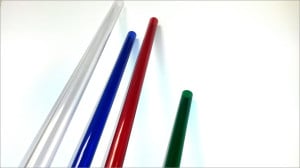
Clear tubes and PVC profiles are widely used in display units, advertising media and fixing systems.
4. Medical and healthcare
Flexible PVC is commonly used in medical settings for applications that require high chemical resistance and strict hygiene, such as protective sleeving or fluid transfer tubing.
5. Packaging and logistics
With its strength and low weight, PVC is widely used for cores, storage tubes and protective sleeving in industrial packaging.
6. Lighting and signage
Crystal-clear PVC tubes are commonly used in LED lighting systems, where they diffuse light evenly and provide mechanical protection.
Manufacturing and quality control at ABI Profils
At ABI Profils, PVC products are made by plastic extrusion, in an optimised, reliable and fully controlled production flow.
- 15 single-screw and twin-screw extrusion lines for high-capacity production
- Co-extrusion and post-extrusion technologies to combine several materials (rigid/flexible, clear/opaque)
- Custom finishing: cutting, punching, inkjet marking and other custom operations
- Strict quality control: every product is tested for dimensional stability and durability
With this expertise, we supply PVC tubes, profiles and sleeving for the most demanding environments (construction, medical, transport, aeronautics), with consistent quality and high reliability.
Need an extrusion expert for your PVC products?
Call us on +33 4 71 61 29 99 or use our online form for personal support.
FAQ: extrusion of PVC tubes and profiles
Rigid PVC is used for tubes and profiles that need high dimensional stability and mechanical strength. Flexible PVC is more elastic and is chosen for applications such as protective sleeving, plastic strips or some medical components.
Tolerances depend on the geometry and the manufacturing conditions. At ABI Profils, production follows the French standard NF T 58-000 (standard class), which sets dimensional accuracy criteria for extruded products. This ensures compliance and repeatability, while allowing adjustments to customer specifications.
Several operations can be added:
- In-line: straight or angled cutting, drilling, punching, threading, inkjet marking (traceability), adhesive application
- Post-extrusion: special cuts, machining, threading, assembly, custom operations
These operations are carried out either in-line or in our post-extrusion workshop, to keep lead times short.
Yes. Some PVC formulations are stabilised to withstand UV, weathering and aggressive chemical environments. They are particularly well suited to outdoor and industrial applications.
Enjoyed this article? Share it:
Our other news
17 September 2025
Else Carden joins ABI Profils’ international team
International development is central to ABI Profils’ growth strategy. As part of this ambition, we are pleased to welcome Else Carden to our sales team. Her international experience will be a valuable asset as ABI Profils expands across Europe.

17 September 2025
PVC or PP tubes: which material for which application?
In many industries, from construction and food processing to transport, chemicals and logistics, plastic tubes play a key functional role. PVC (polyvinyl chloride) and PP (polypropylene) are two of the most widely used materials, each with its own technical advantages. Mechanical strength, chemical resistance, weight, cost, thermal behaviour, ease of processing: the choice between a PVC tube and a PP tube depends directly on the technical constraints of the application.
15 September 2025
Rigid transparent plastic tubes: selection criteria for industrial use
Rigid transparent plastic tubes are essential in many industries. They are widely used in lighting, signage, medical applications and design projects. Their transparency and mechanical strength make them indispensable components. But how do you choose the right material? Which characteristics matter most for performance and durability in demanding environments?