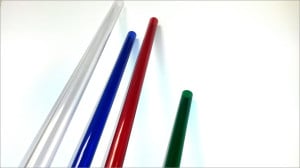


PVC or PP tubes: which material for which application?
In many industries, from construction and food processing to transport, chemicals and logistics, plastic tubes play a key functional role. PVC (polyvinyl chloride) and PP (polypropylene) are two of the most widely used materials, each with its own technical advantages. Mechanical strength, chemical resistance, weight, cost, thermal behaviour, ease of processing: the choice between a PVC tube and a PP tube depends directly on the technical constraints of the application. Need advice? Call our team on +33 4 71 61 29 99 or use our online form.
Characteristics of PVC tubes
Rigid PVC is widely used to make plastic tubes for demanding industrial environments. It is valued for its strength, chemical resistance and dimensional stability.
Advantages of PVC tubes
- High mechanical strength: PVC offers excellent rigidity and resistance to compression.
- Dimensional stability: it keeps its structural properties even when exposed to temperature variations.
- Good chemical resistance: it withstands oils, solvents and common chemicals.
- Durability: its long service life is a major advantage in industries that need robust components.
- Compliance with industrial standards: suitable for sectors with strict regulations.
Applications of PVC tubes
- Construction: fluid conveyance, electrical cable protection.
- Agriculture: cores for winding agricultural film, irrigation pipes
- Textiles and packaging: cores for winding film, adhesive tape and plastic sheeting
- Chemical industry: pipework for corrosive products
Characteristics of PP tubes
Polypropylene (PP) is a thermoplastic known for its low density, flexibility and excellent chemical resistance. It is often used when specific mechanical behaviour is required.
Advantages of PP tubes
- Lightweight: lower density than PVC, for easier handling and a lighter overall system.
- Good thermal resistance: better tolerance of high temperatures without degrading.
- Excellent chemical resistance: tolerates acids, bases and industrial solvents.
- Greater flexibility: unlike PVC, PP offers elasticity that reduces breakage under mechanical stress.
- Recyclability: fully recyclable, a key advantage for sustainability-focused applications
Applications of PP tubes
- Food industry: suitable for food contact; widely used in film production and packaging
- Medical sector: components that require non-toxic materials and resistance to disinfectants
- Chemical industry: pipework exposed to corrosive products
- Automotive: protective sleeving for cables and fluid lines
How to choose: comparison by application
Choosing between a PVC tube and a PP tube depends mainly on the operating environment and the technical constraints.
Which material for which need?
- Need high rigidity and mechanical strength? → PVC is more suitable
- Exposure to aggressive chemicals? → PP offers superior chemical resistance
- High temperatures? → PP withstands thermal variations better
- Need a lightweight tube? → PP is easier to handle
- Regulated environments (food, medical)? → PP is often the more compliant choice
Why choose ABI Profils?
At ABI Profils, we have mastered extrusion, co-extrusion and post-extrusion for PVC and PP tubes. Our versatile production equipment lets us:
- Adapt formulations to improve UV, impact or thermal resistance
- Make custom tubes to your specifications: diameter, wall thickness, rigidity, flexibility, colour
- Add specific finishing operations (cutting, drilling, marking, adhesive application)
- Meet regulatory requirements (food contact, REACH, RoHS, etc.)
Our tubes are used in construction, chemicals, the medical sector, transport and many other sectors where reliable plastic tubes are essential.
Our teams can help you choose the material best suited to your project. Call us on +33 4 71 61 29 99 or use our online form for a detailed review of your requirements.
Frequently asked questions
PVC is recommended when high mechanical strength and chemical resistance are required. PP is preferred for its light weight and its excellent resistance to high temperatures and aggressive chemicals.
Yes, both materials are recyclable. PP is generally easier to recycle and retains its properties better. PVC needs more specific recycling processes because of the additives it may contain.
- PVC tubes: plumbing, electrical conduit and applications that require rigidity
- PP tubes: environments with wide temperature variations, such as the food and chemical industries
- PP has limited natural UV resistance, but it can be UV-stabilised with additives.
- Rigid PVC has better inherent UV resistance and is better suited to outdoor use.
It depends on the operating conditions. PVC is known for its dimensional stability and weather resistance, and often lasts over 50 years outdoors. PP is more sensitive to environmental conditions but remains a durable choice for many industrial uses.
Enjoyed this article? Share it:
Our other news
17 September 2025
Else Carden joins ABI Profils’ international team
International development is central to ABI Profils’ growth strategy. As part of this ambition, we are pleased to welcome Else Carden to our sales team. Her international experience will be a valuable asset as ABI Profils expands across Europe.

17 September 2025
PVC as a technical material: properties, advantages and industrial applications
PVC (polyvinyl chloride) is one of the most widely used thermoplastic polymers in industry. Its versatility, durability and mechanical performance make it a key material for technical tubes, profiles, winding cores and protective sleeving. Available in rigid and flexible grades, PVC meets the requirements of many sectors, including construction, automotive, signage, packaging and medical.
15 September 2025
Rigid transparent plastic tubes: selection criteria for industrial use
Rigid transparent plastic tubes are essential in many industries. They are widely used in lighting, signage, medical applications and design projects. Their transparency and mechanical strength make them indispensable components. But how do you choose the right material? Which characteristics matter most for performance and durability in demanding environments?