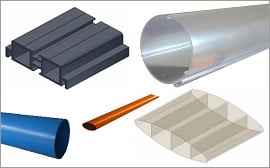


Latest developments: innovation and industrial performance at ABI Profils
Once again this year, ABI Profils reports a strong increase in production, driven by three key factors: continuous operator training, investment in research and development, and the ongoing optimisation of its production equipment.
Continuous growth driven by training and R&D
The industrial performance of ABI Profils rests first and foremost on the skills and expertise of its teams. Continuous upskilling of operators, combined with an active R&D strategy, helps the company anticipate market trends and deliver ever higher-performing extruded products that keep pace with changing industrial requirements.
A production site dedicated to plastic extrusion
ABI Profils’ production site, fully dedicated to the extrusion of plastic profiles, tubes, strips and conduit, shows every day its ability to innovate, adapt and evolve with new applications, technical constraints and changing consumption patterns.
This adaptability is reflected in the design and manufacture of high-performance extrusion tooling for plastic profiles, tubing, strips and co-extruded components.
Technological innovation and advanced co-extrusion
ABI Profils continuously adopts innovative technologies, particularly for two-material co-extruded profiles and co-extruded plastic tubes.
These technologies help the company meet increasingly demanding functional, aesthetic and technical requirements, with high-value extruded products for complex industrial applications.
Environmental commitment and QSE strategy
Sustainability is fully embedded in ABI Profils’ industrial strategy. The company applies a strong environmental policy focused on cleaner materials, backed by targeted investment in production lines for filled, additive-enhanced or reinforced polyolefins.
These lines produce PP and PE tubes, as well as plastic cores for winding applications, in compliance with current environmental regulations.
ABI Profils has also fully adopted a QSE (quality, safety and environment) approach, backed by an active occupational safety and risk prevention policy and a voluntary partnership with the regional health insurance fund in Clermont-Ferrand, under a performance contract for the continuous improvement of industrial processes.
Materials expertise for many industries
The range of PVC profiles and PVC tubes, standard or custom, is continuously expanding. ABI Profils’ expertise in polymer processing covers a wide variety of materials, including:
- Polypropylenes and polyethylenes (glass-fibre or mineral-filled)
- ABS and PS
- Polycarbonates
- Polyamides
- Rigid and flexible PVC, coloured or transparent
- EPDM and SEBS
- Conductive or antistatic materials (ESD)
This materials expertise lets ABI Profils design custom plastic profiles and tubes for industries such as automotive, construction, sports and leisure, electromechanics and packaging, with a constant focus on performance, quality and customer satisfaction.
Enjoyed this article? Share it:
Our other news
17 September 2025
Else Carden joins ABI Profils’ international team
International development is central to ABI Profils’ growth strategy. As part of this ambition, we are pleased to welcome Else Carden to our sales team. Her international experience will be a valuable asset as ABI Profils expands across Europe.
17 September 2025
PVC or PP tubes: which material for which application?
In many industries, from construction and food processing to transport, chemicals and logistics, plastic tubes play a key functional role. PVC (polyvinyl chloride) and PP (polypropylene) are two of the most widely used materials, each with its own technical advantages. Mechanical strength, chemical resistance, weight, cost, thermal behaviour, ease of processing: the choice between a PVC tube and a PP tube depends directly on the technical constraints of the application.
17 September 2025
PVC as a technical material: properties, advantages and industrial applications
PVC (polyvinyl chloride) is one of the most widely used thermoplastic polymers in industry. Its versatility, durability and mechanical performance make it a key material for technical tubes, profiles, winding cores and protective sleeving. Available in rigid and flexible grades, PVC meets the requirements of many sectors, including construction, automotive, signage, packaging and medical.