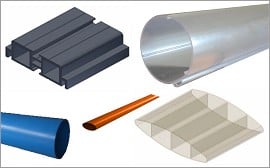


Which material should you choose for your plastic tubes and profiles?
Material selection directly affects the strength, durability, and suitability of a plastic tube or profile for its intended environment. Depending on the application, some projects require high rigidity, while others demand greater flexibility or specific chemical resistance. At ABI Profils, we offer a wide range of plastic materials adapted to many industrial sectors. This article aims to help you better understand the properties and uses of the main materials used in plastic extrusion, so you can make a relevant and long-lasting choice. Need advice? Contact one of our project managers at +33 4 71 61 29 99 or via our online contact form.
Comparison of plastic materials
Polyvinyl chloride (PVC)
PVC is one of the most widely used materials in plastic extrusion. It is available in rigid and flexible versions, depending on functional and mechanical requirements.
| Property | Rigid PVC | Flexible PVC |
|---|---|---|
| Rigidity | High | Flexible, good impact resistance |
| Chemical resistance | Good (acids, bases) | Excellent (chemicals, oils) |
| Electrical insulation | Excellent | Moderate |
| Applications | Technical profiles, conduits, electrical tubes | Protective sleeves, strips |
| Industries | Electrical, construction, industry | Medical, packaging, protection |
| Drawbacks | UV-sensitive without stabilisation | May become brittle over time |
Polypropylene (PP)
Polypropylene is valued for its light weight and chemical resistance. It is commonly used in food processing and packaging.
| Property | Details |
|---|---|
| Weight | Very lightweight |
| Chemical resistance | Excellent, especially to acids |
| Heat resistance | Up to 100°C |
| Recyclability | Good |
| Applications | Core tubes, industrial profiles |
| Industries | Packaging, food industry, automotive |
| Drawbacks | UV-sensitive, less rigid than PVC |
High-Density Polyethylene (HDPE / PEHD)
HDPE stands out for its excellent impact resistance. It is particularly suitable for fluid transport and demanding industrial environments.
| Property | Details |
|---|---|
| Impact Resistance | High |
| Chemical resistance | Compatible with solvents and weak acids |
| Flexibility | Medium, higher than PVC |
| Applications | Industrial tubes, cores |
| Industries | Fluid transport, agriculture, chemical storage |
| Drawbacks | Less rigid than PVC, difficult to glue |
Mineral-Reinforced HDPE C
Mineral-reinforced HDPE C provides higher rigidity and excellent dimensional stability. It is recommended for high mechanical load applications.
| Property | Details |
|---|---|
| Rigidity | Higher than standard HDPE |
| Dimensional stability | Very good |
| Applications | High-load mechanical uses |
| Industries | Heavy industry, construction, transport |
| Drawbacks | Heavier than standard HDPE |
Acrylonitrile Butadiene Styrene (ABS)
ABS is known for its strength and high-quality surface finish. It is widely used for technical parts with strong aesthetic requirements.
| Property | Details |
|---|---|
| Impact resistance | High |
| Heat resistance | Good (up to 80°C) |
| Finish | Smooth, aesthetic surface |
| Applications | Technical profiles, electronic components |
| Industries | Electronics, automotive, furniture |
| Drawbacks | UV-sensitive, less solvent-resistant |
High-Impact Polystyrene (HIPS / PS)
High-impact polystyrene is mainly used in packaging and point-of-sale display (POS).
| Property | Details |
|---|---|
| Rigidity | High |
| Impact resistance | Good |
| Applications | Packaging, electronics |
| Industries | Food packaging, POS, advertising |
| Drawbacks | Lower weather resistance |
Which material for your application?
Materials for plastic tubes
- HDPE (PEHD): High impact and abrasion resistance, ideal for industry and dynamic storage
- PP: Lightweight, recommended for packaging and food applications
- ABS: Strong with aesthetic finish, commonly used in automotive and furniture
- PVC: Excellent electrical insulation and chemical resistance
Materials for other types of profiles
- Plastic rods (solid profiles): Rigid or flexible, made from PVC, PP, HDPE, or ABS, available in coils or cut lengths
- Flexible plastic conduits: Made from flexible PVC, SEBS, or LDPE, ideal for protection and flexibility
- Flexible plastic strips: Made from flexible PVC or SEBS, used in construction, signage, leisure, and industrial applications
Contact our specialists
Choosing the right material for your plastic tubes or profiles depends on many constraints: impact resistance, chemical properties, temperature tolerance, rigidity, and recyclability. Each industry has specific requirements that must be carefully defined upstream.
To support you, the ABI Profils team puts its expertise at your service to help you select the most suitable material for your application.
Need advice or a quote? Contact us via our online form or by phone at +33 4 71 61 29 99.
FAQ – Frequently asked questions
There are several types of plastic profiles:
- Co-extruded profiles: Multiple materials combined for optimised performance
- Rigid profiles: Suitable for industrial environments requiring stability
- Flexible profiles: Often made from PVC or SEBS for applications requiring flexibility
- Technical profiles: Developed for demanding sectors such as automotive or aerospace
Plastic tubes can be classified according to their use:
- Transparent tubes: Used for display, POS, or medical applications
- PVC tubes: Chemical-resistant, used in industry and construction
- Core tubes: Supports for winding plastic films and paper
- PP and HDPE tubes: Lightweight, strong, suitable for food and chemical fluids
- Co-extruded tubes: Multi-layer structures designed for specific technical properties
Plastic extrusion is a continuous manufacturing process used to produce tubes and profiles.
Plastic material is heated, homogenised, and then pushed through a die that shapes the final product.
This process is widely used to obtain precise dimensions and material properties tailored to industrial requirements.
Cet article vous a intéressé ? Partagez le :
Nos autres actus
17 September 2025
ABI Profils strengthens its international team with the arrival of Else CARDEN
At ABI Profils, our commitment to international development is a core element of our growth strategy. As part of this ambition, we are pleased to announce the arrival of Else Carden within our sales team. Her international experience will be a valuable asset in supporting ABI Profils’ expansion across Europe.

17 September 2025
PVC Tubes or PP Tubes? Which performance for which application?
In many industrial sectors — from construction to food processing, as well as transport, chemicals and logistics — plastic tubes play a key functional role. Among the most commonly used materials, PVC (Polyvinyl Chloride) and PP (Polypropylene) stand out as leading solutions, each offering distinct technical advantages. Mechanical strength, chemical resistance, weight, cost, thermal behaviour, ease of processing: the choice between a PVC tube and a PP tube depends directly on the application’s technical constraints.
17 September 2025
PVC as a technical material: properties, advantages and industrial applications
PVC (Polyvinyl Chloride) is one of the most widely used thermoplastic polymers in the industrial world. Its versatility, durability and mechanical performance make it a key material for manufacturing technical tubes, profiles, mandrels and protective sheaths. Available in both rigid and flexible versions, PVC meets the requirements of various sectors such as construction, automotive, signage, packaging and medical.