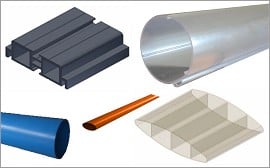


HDPE R Mineral C plastic cores: technology driving industrial performance
HDPE R Mineral C plastic cores stand out thanks to an advanced technical design. They combine the intrinsic properties of high-density polyethylene (HDPE) with the integration of specific mineral fillers, achieving high levels of mechanical performance and dimensional stability. This technology produces plastic cores capable of withstanding significant mechanical loads while maintaining a stable geometry over time. In this article, we explore the technology and material science behind HDPE R Mineral C plastic cores developed by ABI Profils.
Composition of HDPE R Mineral C
HDPE R Mineral C is a composite material created by incorporating mineral fillers into an HDPE polymer matrix. These fillers — such as calcium carbonate or silica — modify the material structure at a microscopic scale.
They act as reinforcement points within the polymer matrix, significantly enhancing the mechanical performance of the plastic core.
Mechanical Reinforcement and Reduced Deformation
The addition of mineral fillers creates a direct interaction between mineral particles and HDPE polymer chains.
This interaction enables:
- Increased resistance to deformation under load
- Reduced ovalisation and creep
- Improved mechanical stability under continuous mechanical stress
Improved mechanical load distribution
Mineral fillers ensure even stress distribution throughout the material. As a result, HDPE R Mineral C plastic cores can support higher mechanical loads while maintaining excellent dimensional stability, which is critical in demanding industrial environments.
Increased material rigidity
The integration of mineral reinforcements increases the overall stiffness of HDPE. This property is particularly valuable for plastic cores used in applications involving high mechanical loads, high rotational speeds, or heavy winding tensions.
Extrusion Technology Applied to HDPE R Mineral C
HDPE R Mineral C plastic cores are manufactured using a controlled plastic extrusion process. This involves melting and homogenising HDPE with mineral fillers before forcing the compound through an extrusion die to form the final plastic core geometry.
This process relies on precise control of several critical parameters.
Temperature and viscosity control
HDPE and mineral fillers must reach a temperature high enough to ensure complete melting, without degrading the material. The melt viscosity is tightly controlled to ensure stable, uniform extrusion.
Homogeneous dispersion of mineral fillers
A uniform dispersion of mineral fillers within the polymer matrix is essential to guarantee consistent mechanical properties across the entire length of the plastic core.
Managing HDPE crystallinity
HDPE is a semi-crystalline polymer. During cooling, molecular chains organise into crystalline regions. Controlled cooling enhances crystallinity, improving:
- Material stiffness
- Mechanical strength
- Dimensional stability of the plastic core
Applications des mandrins en PEHD R Minéral C dans l’industrie
Grâce à leurs propriétés mécaniques renforcées, les mandrins en PEHD R Minéral C sont particulièrement adaptés aux secteurs industriels soumis à de fortes contraintes.
Industrial applications of HDPE R Mineral C plastic cores
Thanks to their reinforced mechanical properties, HDPE R Mineral C plastic cores are particularly well suited to high-stress industrial applications.
Plastic film industry
These plastic cores ensure stable and precise winding of technical plastic films, while resisting deformation caused by winding pressure.
Industrial packaging and technical adhesives
In industrial packaging and technical adhesive applications, these cores meet strict requirements for dimensional accuracy and mechanical resistance, even under intensive operating conditions.
Other high-demand industrial sectors
HDPE R Mineral C plastic cores are also used in industries where durability and reliability are essential, including:
- Automotive
- Electronics
- High-load industrial applications
A durable and high-performance solution
HDPE R Mineral C plastic cores offer superior durability, thanks to their strong resistance to wear and repeated mechanical stress. This longevity helps reduce maintenance and replacement costs.
In addition, this composite material is recyclable, making it a more environmentally responsible solution for industrial manufacturers committed to sustainability.
Conclusion: technical plastic cores for demanding environments
HDPE R Mineral C plastic cores result from an advanced technology combining HDPE performance with targeted mineral reinforcement. This synergy delivers stable, durable, and high-performance plastic cores, ideally suited for demanding industrial environments.
(You can also read our dedicated article on HDPE plastic cores.)
Thanks to its plastic extrusion expertise, ABI Profils designs custom plastic cores precisely tailored to each project’s technical requirements.
To learn more about our HDPE R Mineral C plastic cores and how they can support your industrial needs, contact us via our online form or by phone on +33 4 71 61 29 99.
Cet article vous a intéressé ? Partagez le :
Nos autres actus
17 September 2025
ABI Profils strengthens its international team with the arrival of Else CARDEN
At ABI Profils, our commitment to international development is a core element of our growth strategy. As part of this ambition, we are pleased to announce the arrival of Else Carden within our sales team. Her international experience will be a valuable asset in supporting ABI Profils’ expansion across Europe.
17 September 2025
PVC Tubes or PP Tubes? Which performance for which application?
In many industrial sectors — from construction to food processing, as well as transport, chemicals and logistics — plastic tubes play a key functional role. Among the most commonly used materials, PVC (Polyvinyl Chloride) and PP (Polypropylene) stand out as leading solutions, each offering distinct technical advantages. Mechanical strength, chemical resistance, weight, cost, thermal behaviour, ease of processing: the choice between a PVC tube and a PP tube depends directly on the application’s technical constraints.
17 September 2025
PVC as a technical material: properties, advantages and industrial applications
PVC (Polyvinyl Chloride) is one of the most widely used thermoplastic polymers in the industrial world. Its versatility, durability and mechanical performance make it a key material for manufacturing technical tubes, profiles, mandrels and protective sheaths. Available in both rigid and flexible versions, PVC meets the requirements of various sectors such as construction, automotive, signage, packaging and medical.