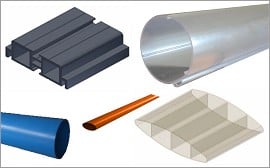


The advantages of plastic core tubes: lightweight, durability and industrial applications
Why choose plastic core tubes over metal or cardboard alternatives? Today, plastic cores have become a benchmark across many industrial sectors thanks to their technical and economic performance. Three key strengths explain this choice: lightweight, durability, and application versatility. These attributes make plastic core tubes a reliable solution for a wide range of industrial operations. In this article, we explore in detail the benefits and use cases of plastic core tubes. Have a specific requirement? Contact our teams via our online form or by phone on +33 4 71 61 29 99.
The lightweight advantage of plastic core tubes: practicality and cost reduction
Lightweight construction is often the first benefit highlighted when discussing plastic core tubes. Compared with metal or cardboard cores, they offer a significantly lower weight, making them easier to handle in industrial environments.
Easier handling in industrial facilities
In warehouses, on production lines, or on worksites, lighter tubes are simpler to manage.
This enables:
- Reduced physical strain for operators
- Lower risk of musculoskeletal disorders and injuries
- Smoother and more efficient logistics operations
Significant reduction in transport costs
Weight directly impacts transport expenses. By lowering overall shipment weight, plastic core tubes help achieve:
- Reduced logistics costs
- Optimised loading efficiency
- Improved shipment profitability, particularly for international transport.
Reduced stress on equipment
Thanks to their low weight, plastic core tubes apply less mechanical load on handling and installation machinery. This contributes to:
- Extended equipment lifespan
- Fewer breakdowns and reduced maintenance requirements
These characteristics make plastic core tubes particularly suitable for weight-sensitive sectors such as aerospace and advanced technical installations.
Durability: a long-lasting and reliable solution
Beyond their lightweight design, plastic core tubes stand out for their excellent durability. The plastic materials used offer high resistance to mechanical and environmental stresses.
Impact resistance and mechanical strength
Materials such as HDPE (High-Density Polyethylene) and ABS (Acrylonitrile Butadiene Styrene) are selected for their ability to absorb impacts without cracking or breaking.
These properties are essential in environments where tubes are:
- Frequently handled
- Exposed to demanding transport conditions
- Subjected to repeated mechanical stress.
Excellent chemical resistance
Plastic core tubes are often used in environments exposed to chemicals. Materials such as PVC or PP (Polypropylene) provide strong resistance to corrosive substances, making them suitable for:
- Chemical industry
- Pharmaceutical industry
- Technical industrial applications.
Resistance to weather and outdoor conditions
Certain plastics, including PVC and SEBS, offer excellent resistance to:
- UV radiation
- Humidity
- Temperature fluctuations
These properties ensure reliable performance in outdoor applications, including construction, signage, and temporary installations.
Thanks to their long service life, plastic core tubes reduce replacement frequency and help maintain continuous production.
Application versatility of plastic core tubes
Versatility is one of the main strengths of plastic core tubes. At ABI Profils, they are designed to meet the requirements of multiple industrial sectors.
Food and pharmaceutical industries
In industries governed by strict hygiene and safety standards, plastic core tubes are used for:
- Winding food-grade films (HDPE or PS cores)
- Pharmaceutical packaging requiring cleanliness and protection for sensitive products
Electronics industry
Plastic core tubes are also used for winding and protecting cables and electronic components.
Materials such as ABS or PVC provide:
- Excellent electrical insulation
- Good thermal resistance.
Industrial packaging and POS displays
In industrial packaging and POS (Point of Sale) displays, plastic core tubes enable:
- Storage and winding of films, tapes and plastic media
- Optimal protection of products during transport and shipping
Aerospace, sports and other technical sectors
In industries where lightweight and strength are critical — such as aerospace, sports and leisure, and signage — plastic core tubes are used for:
- Protecting sensitive components
- Technical applications requiring high reliability and durability.
Manufacturing process of plastic core tubes at ABI Profils
At ABI Profils, plastic core tubes are produced using plastic extrusion, a process that ensures consistent quality and stable performance.
We operate 15 single-screw and twin-screw extrusion lines, supported by a high-output twin-screw line, enabling:
- Fully custom manufacturing
- Adjustable diameters, lengths, and materials
- Compliance with demanding technical specifications
Each material is selected according to the specific constraints of your project.
Conclusion: plastic core tubes tailored to industrial requirements
Plastic core tubes represent a solution that is practical, durable, and highly versatile. Their lightweight structure, resistance to mechanical and environmental stress, and adaptability to diverse industrial applications make them a strategic choice across many sectors.
At ABI Profils, we bring over 50 years of expertise in plastic extrusion to design custom plastic core tubes tailored to your technical, aesthetic, and environmental requirements.
Have a project or specific constraints? Contact us now via our online form or by phone on +33 4 71 61 29 99.
Cet article vous a intéressé ? Partagez le :
Nos autres actus
17 September 2025
ABI Profils strengthens its international team with the arrival of Else CARDEN
At ABI Profils, our commitment to international development is a core element of our growth strategy. As part of this ambition, we are pleased to announce the arrival of Else Carden within our sales team. Her international experience will be a valuable asset in supporting ABI Profils’ expansion across Europe.

17 September 2025
PVC Tubes or PP Tubes? Which performance for which application?
In many industrial sectors — from construction to food processing, as well as transport, chemicals and logistics — plastic tubes play a key functional role. Among the most commonly used materials, PVC (Polyvinyl Chloride) and PP (Polypropylene) stand out as leading solutions, each offering distinct technical advantages. Mechanical strength, chemical resistance, weight, cost, thermal behaviour, ease of processing: the choice between a PVC tube and a PP tube depends directly on the application’s technical constraints.
17 September 2025
PVC as a technical material: properties, advantages and industrial applications
PVC (Polyvinyl Chloride) is one of the most widely used thermoplastic polymers in the industrial world. Its versatility, durability and mechanical performance make it a key material for manufacturing technical tubes, profiles, mandrels and protective sheaths. Available in both rigid and flexible versions, PVC meets the requirements of various sectors such as construction, automotive, signage, packaging and medical.