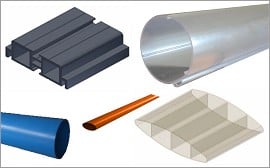


HDPE plastic cores: strength, lightweight performance and industrial adaptability
HDPE (High-Density Polyethylene) plastic cores are now a benchmark solution across many industrial sectors. Their versatility, mechanical strength and low weight make them particularly suitable for demanding applications such as plastic film winding, technical adhesive rolls, and sterile films used in the medical sector. As an expert in plastic extrusion and co-extrusion, ABI Profils explains why HDPE is a key material for plastic core manufacturing and the concrete advantages it delivers to industrial users.
Why choose HDPE for your plastic cores?
High-Density Polyethylene (HDPE) is a thermoplastic polymer produced through the polymerisation of ethylene gas. Its linear molecular structure gives it excellent mechanical properties, combining rigidity, impact resistance, and lightweight performance.
These characteristics make HDPE particularly suitable for plastic cores designed for intensive industrial use, where reliability and durability are essential.
Key advantages of HDPE plastic cores
- Lightweight and mechanical strength: Despite its low weight, HDPE provides sufficient strength to withstand significant loads. HDPE plastic cores are therefore easy to handle while maintaining long-term mechanical stability.
- Excellent chemical resistance: HDPE is resistant to a wide range of chemical substances, making it ideal for industrial environments exposed to corrosive or aggressive agents, without compromising material performance.
- Impermeability and hygiene: Thanks to its structure, HDPE is impermeable to liquids. This property is critical for applications requiring high levels of hygiene and safety, particularly in the food and medical sectors.
Industrial adaptability: custom HDPE plastic cores
One of the key strengths of HDPE plastic cores lies in their industrial adaptability. Every production environment imposes specific constraints in terms of dimensions, mechanical strength, tolerances, and operating conditions.
At ABI Profils, we design custom plastic cores, fully tailored to your technical and operational requirements.
Our HDPE plastic cores can be manufactured:
- In a wide range of diameters and lengths
- With different internal finish options (smooth or ribbed)
- According to your functional and technical specifications
Your core is therefore engineered to integrate seamlessly into your industrial process.
Industrial applications of HDPE plastic cores
Thanks to their versatility and reliability, HDPE plastic cores are used across multiple industrial sectors.
Food industry
HDPE plastic cores are widely used for winding food-grade plastic films. Their impermeability and mechanical strength ensure high hygiene standards and safe operation.
Technical adhesives
In the technical adhesives sector, the dimensional accuracy of HDPE plastic cores helps maintain tight tolerances and consistent winding quality, which is essential for performance and product integrity.
Medical sector
HDPE plastic cores are also used for winding sterile films. Their non-toxicity, chemical resistance, and dimensional stability meet the strict requirements of medical and healthcare applications.
A durable and high-performance solution
Beyond their mechanical performance, HDPE plastic cores offer a long-lasting and cost-effective solution. Their wear resistance and long service life reduce the need for frequent replacements, helping to lower maintenance costs.
In addition, HDPE is a recyclable material. At ABI Profils, we integrate this environmental dimension to provide more responsible and sustainable solutions for manufacturers seeking to reduce their ecological footprint.
Conclusion: why choose HDPE plastic cores?
HDPE plastic cores represent a reliable, high-performance, and durable technical solution for many industrial sectors. Their strength, combined with their lightweight design and high adaptability, makes them perfectly suited to the demands of modern production lines.
At ABI Profils, we work closely with our customers to design custom HDPE plastic cores precisely adapted to their industrial constraints.
To learn more about our HDPE plastic cores or to discuss your project, contact us via our online form or by phone on +33 4 71 61 29 99.
Cet article vous a intéressé ? Partagez le :
Nos autres actus
17 September 2025
ABI Profils strengthens its international team with the arrival of Else CARDEN
At ABI Profils, our commitment to international development is a core element of our growth strategy. As part of this ambition, we are pleased to announce the arrival of Else Carden within our sales team. Her international experience will be a valuable asset in supporting ABI Profils’ expansion across Europe.
17 September 2025
PVC Tubes or PP Tubes? Which performance for which application?
In many industrial sectors — from construction to food processing, as well as transport, chemicals and logistics — plastic tubes play a key functional role. Among the most commonly used materials, PVC (Polyvinyl Chloride) and PP (Polypropylene) stand out as leading solutions, each offering distinct technical advantages. Mechanical strength, chemical resistance, weight, cost, thermal behaviour, ease of processing: the choice between a PVC tube and a PP tube depends directly on the application’s technical constraints.
17 September 2025
PVC as a technical material: properties, advantages and industrial applications
PVC (Polyvinyl Chloride) is one of the most widely used thermoplastic polymers in the industrial world. Its versatility, durability and mechanical performance make it a key material for manufacturing technical tubes, profiles, mandrels and protective sheaths. Available in both rigid and flexible versions, PVC meets the requirements of various sectors such as construction, automotive, signage, packaging and medical.