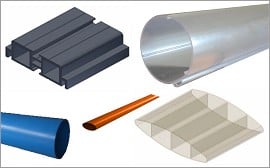


Different plastic profiles and their application areas
At ABI Profils, our expertise in plastic extrusion, co-extrusion, tri-extrusion, and post-extrusion enables us to meet the diverse needs of multiple industrial sectors. In this article, we present the main types of plastic profiles, their technical characteristics, and their industrial application fields. Do you have a plastic extrusion project? Contact us via our online form or by phone on +33 4 71 61 29 99.
Manufacturing and technical characteristics of plastic profiles
Plastic profiles are manufactured through the extrusion of thermoplastic materials. Depending on the polymer used, they offer a wide range of technical properties and strong versatility, often outperforming metal profiles in weight and adaptability.
They are particularly valued for:
- Lightweight construction
- Mechanical strength
- Flexibility
- Ability to achieve complex and custom geometries
At ABI Profils, we analyse over 300 projects per year. Our teams have strong R&D capabilities to design and develop custom extrusion tooling, from initial concept through to serial production.
We do not simply manufacture plastic profiles — we deliver functional industrial components designed to display, protect, insulate, guide, and reinforce.
Specific plastic profiles and ABI Profils solutions
IProfils joining profiles
In addition to technical profiles, ABI Profils offers a dedicated range of edge-to-edge joining profiles known as IProfils.
These solutions are designed for joining polished glass partitions, ensuring high-quality assembly and clean finishing.
In partnership with TESA, a leading European adhesive manufacturer, the ACX Plus solution meets both functional and aesthetic requirements for crossbar-free bonding systems.
Plastic materials used for extrusion
The production of plastic profiles relies primarily on thermoplastics, materials that can be reshaped under heat and solidified through cooling.
Key targeted properties include:
- Mechanical resistance
- Flexibility
- Transparency
- UV resistance
- Chemical resistance
- Temperature resistance
Materials used at ABI Profils
We work with a wide range of polymers, including: PVC, HDPE, LDPE, PP, glass-fibre reinforced PP, PMMA, SEBS, PC, PA, reinforced PA, ABS, PS, PETG.
Material selection depends strictly on your technical specifications.
For example:
- PVC is valued for its rigidity and weather resistance
- PE is preferred for its flexibility and durability
Our extrusion dies also allow multi-material and multi-colour combinations through co-extrusion, tri-extrusion, and post-extrusion.
Application areas of plastic profiles
Construction and building
In the construction sector, plastic profiles are used for:
- Façade trims
- Sealing profiles
- Fluid transport tubing
- Signage products
They offer strong thermal and acoustic insulation, as well as excellent UV and impact resistance.
Automotive industry
In automotive manufacturing, plastic profiles help reduce vehicle weight while improving safety, comfort, and design.
Typical applications include:
- Seals
- Air ducts
- Cable routing
- AdBlue containers
- Trim profiles and airbag supports
ABI Profils is specialised in bi-material profiles and custom extrusion solutions tailored to the demanding automotive sector.
Food and packaging industry
Plastic profiles play a key role in the protection, transport, and preservation of food and industrial products, in compliance with hygiene standards.
Applications include:
- Food packaging tubes
- Protective tubing for electronic components
- Packaging consumables.
Dynamic storage systems
In dynamic storage, plastic profiles are used for:
- Guiding goods
- Impact protection
- ESD (electrostatic discharge) management
Relevant products include:
- Guide rails
- Structural profiles
- Protective tubes
Paramedical sector
The paramedical field requires solutions that are hygienic, safe, and durable.
ABI Profils develops:
- Support and reinforcement profiles
- Medical application tubing
- Decorative and protective covers for medical equipment
POS (Point of Sale Displays)
In POS and retail display, plastic profiles are valued for transparency, durability, and ease of installation:
- Label holders
- Poster clips
- Slotted display tubes
Sports and leisure
Plastic profiles for sports and leisure must withstand outdoor exposure and mechanical stress:
- Swimming pools
- Toys
- Public equipment
- Snow poles and ski resort marking systems
Aerospace
The aerospace sector requires lightweight, high-strength, and reliable materials.
Applications include:
- Sealing ducts
- Bi-material co-extruded components
- Harness reinforcements
- Decorative and finishing profiles
Conclusion
Plastic profiles, manufactured through extrusion and co-/tri-/post-extrusion of thermoplastics, have become essential across many industrial sectors: construction, automotive, POS, packaging, paramedical, sports and leisure, dynamic storage, and aerospace.
At ABI Profils, we are committed to delivering custom-made extrusion solutions, supported by strict quality control and comprehensive assistance from design to production.
Contact and support from ABI Profils
Do you have a specific request or a project requiring custom plastic extrusion expertise?
Our team is available to analyse your needs and propose tailored technical solutions.
Contact us via our online form or by phone on +33 4 71 61 29 99.
Cet article vous a intéressé ? Partagez le :
Nos autres actus
17 September 2025
ABI Profils strengthens its international team with the arrival of Else CARDEN
At ABI Profils, our commitment to international development is a core element of our growth strategy. As part of this ambition, we are pleased to announce the arrival of Else Carden within our sales team. Her international experience will be a valuable asset in supporting ABI Profils’ expansion across Europe.
17 September 2025
PVC Tubes or PP Tubes? Which performance for which application?
In many industrial sectors — from construction to food processing, as well as transport, chemicals and logistics — plastic tubes play a key functional role. Among the most commonly used materials, PVC (Polyvinyl Chloride) and PP (Polypropylene) stand out as leading solutions, each offering distinct technical advantages. Mechanical strength, chemical resistance, weight, cost, thermal behaviour, ease of processing: the choice between a PVC tube and a PP tube depends directly on the application’s technical constraints.
17 September 2025
PVC as a technical material: properties, advantages and industrial applications
PVC (Polyvinyl Chloride) is one of the most widely used thermoplastic polymers in the industrial world. Its versatility, durability and mechanical performance make it a key material for manufacturing technical tubes, profiles, mandrels and protective sheaths. Available in both rigid and flexible versions, PVC meets the requirements of various sectors such as construction, automotive, signage, packaging and medical.