

Plastic profiles vs co-extruded profiles: key differences
Plastic profiles and co-extruded profiles are technical components widely used across many industrial sectors: automotive, construction, dynamic storage, packaging, paramedical, POS display, and more. Although both rely on plastic extrusion, they differ significantly in terms of manufacturing process, functional properties, and final applications. As an expert in extrusion, co-extrusion, tri-extrusion, and post-extrusion, ABI Profils provides a clear and structured overview to help you choose the most suitable solution for your technical requirements. A comparison table at the end of this article summarises the key differences.
What is a plastic profile
Definition and manufacturing principle
A plastic profile is a component produced by extruding a plastic material through a die.
Extrusion is a continuous transformation process in which thermoplastic material is heated, plasticised, and pushed under pressure through an extruder to form a constant cross-section.
This process ensures high dimensional accuracy and excellent production repeatability.
Examples of plastic profiles
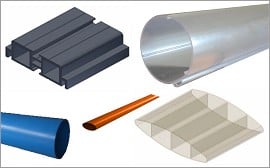
Plastic profiles can be manufactured in many shapes and configurations:
- Single-wall or tubular plastic profiles
- Single-colour or multi-colour plastic profiles
- Opaque or transparent plastic profiles
- Flexible or rigid plastic profiles
- Thin- or thick-wall profiles
- Profiles with additional finishing options
- Semi-finished products (assembly, mounting)
- Label holders, display clips, gripping profiles, POS profiles, etc.
Plastic material used
At ABI Profils, we manufacture standard and custom plastic profiles using a wide range of thermoplastics, selected according to technical, mechanical, and environmental requirements.
Common materials include: PVC, PP, PP GF, PE, PMMA, SEBS, PC, PA, PA GF, ABS, PS, PETG, ASA, TPV, TPU, and more.
Each material offers specific properties such as rigidity, flexibility, chemical resistance, UV resistance, and electrical or thermal insulation.
What is a co-extruded profile?
Principle of plastic co-extrusion
Co-extrusion is a more advanced process than standard extrusion. It involves extruding two or more plastic materials simultaneously using multiple extruders feeding into a single die.
This allows multiple properties to be combined in a single profile, such as rigidity, flexibility, sealing performance, chemical resistance, or enhanced aesthetics.
At ABI Profils, co-extrusion is used to produce bi-material, tri-material, and multi-colour profiles for demanding technical specifications.
Extrusion technologies mastered by ABI Profils
Co-extrusion
Co-extrusion combines two different materials within a single profile.
Examples:
- A rigid structural section
- A flexible sealing or clipping section
- Two colours for aesthetic or identification purposes
Tri-extrusion
Tri-extrusion uses three materials extruded simultaneously.
It enables more advanced property combinations such as rigidity, flexibility, chemical barrier performance, and UV protection, making it ideal for complex technical applications.
Post-extrusion
Post-extrusion involves extruding a primary section, then adding a second material downstream in the process.
It is used to add functions such as:
- Sealing
- Clip-on features
- Shock absorption
Plastic profiles vs co-extruded profiles: comparison table
| Criteria | Plastic profiles | Co-extruded profiles |
|---|---|---|
| Manufacturing process | Single extrusion with one extruder | Complex process with a main extruder and one or more co-extruders |
| Material properties | Properties linked to a single material (rigidity, flexibility, resistance) | Combination of multiple properties within a single profile |
| Applications | Automotive, construction, dynamic storage, paramedical, POS | Technical applications requiring multiple integrated functions (sealing, insulation, multi-material performance) |
| Production cost | Lower cost due to simplified process | Higher cost due to process complexity and functional added value |
| ABI Profils added value | Strength, durability, thermal and electrical insulation | Multi-functionality, multilayer design, advanced customisation |
How to choose between a plastic profile and a co-extruded profile?
The right choice depends on:
- Your functional requirements
- Expected mechanical and chemical performance
- The complexity of your application
- Your economic objectives
Standard plastic profiles are ideal for simple, efficient, and cost-effective solutions.
Co-extruded profiles are designed for advanced technical applications requiring multiple integrated functions in a single product.
Conclusion: ABI Profils expertise at the service of your profiles
At ABI Profils, we design and manufacture custom plastic and co-extruded profiles tailored to your industrial needs.
Our engineering department and technical teams support you from design through production, with full control over extrusion and co-extrusion processes.
Contact us for your projects
Do you have a specific request or a project requiring custom plastic extrusion expertise?
Our team is available to analyse your needs and propose tailored solutions.
Contact us via our online form or by phone at +33 4 71 61 29 99.
Cet article vous a intéressé ? Partagez le :
Nos autres actus
17 September 2025
ABI Profils strengthens its international team with the arrival of Else CARDEN
At ABI Profils, our commitment to international development is a core element of our growth strategy. As part of this ambition, we are pleased to announce the arrival of Else Carden within our sales team. Her international experience will be a valuable asset in supporting ABI Profils’ expansion across Europe.

17 September 2025
PVC Tubes or PP Tubes? Which performance for which application?
In many industrial sectors — from construction to food processing, as well as transport, chemicals and logistics — plastic tubes play a key functional role. Among the most commonly used materials, PVC (Polyvinyl Chloride) and PP (Polypropylene) stand out as leading solutions, each offering distinct technical advantages. Mechanical strength, chemical resistance, weight, cost, thermal behaviour, ease of processing: the choice between a PVC tube and a PP tube depends directly on the application’s technical constraints.
17 September 2025
PVC as a technical material: properties, advantages and industrial applications
PVC (Polyvinyl Chloride) is one of the most widely used thermoplastic polymers in the industrial world. Its versatility, durability and mechanical performance make it a key material for manufacturing technical tubes, profiles, mandrels and protective sheaths. Available in both rigid and flexible versions, PVC meets the requirements of various sectors such as construction, automotive, signage, packaging and medical.