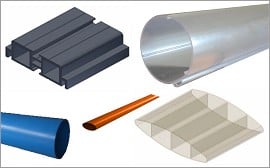


Manufacturing plastic tubes: from extrusion to custom finishing
At ABI Profils, every plastic tube is developed as a bespoke product. No catalogue, no standardised references — only precise and adaptable industrial expertise dedicated to meeting the technical requirements of our customers. This article offers a clear and concrete overview of the different stages involved in manufacturing an extruded plastic tube, from material selection to tailored finishing options.
Expertise in flexible and rigid plastic tubes
For more than 50 years, we have been designing and manufacturing plastic tubes for a wide range of industrial applications. Depending on each project’s requirements, we produce rigid PVC tubes as well as flexible PE or PP tubes.
We work with a wide choice of diameters, wall thicknesses, colours and mechanical or chemical properties, always based on a detailed technical specification.
Our production equipment allows us to manufacture technical plastic tubes in HDPE, PP, rigid PVC, flexible PVC, PS, ABS and other specific formulations. Whether transparent tubes, heat-resistant tubes or food-grade tubes, every product is designed to meet its intended use.
Discover all our plastic tubes here.
Plastic extrusion at the heart of the process
The manufacturing of a plastic tube begins with an extrusion phase. The raw material is heated and homogenised inside a rotating screw before being pushed into a custom-made die. The extruded tube takes shape continuously as it exits the tool.
At ABI Profils, extrusion can be single-screw or twin-screw depending on production constraints. We also offer co-extrusion solutions, for example to combine several materials into a multi-layer tube. This process is ideal when complementary properties are required — mechanical strength, flexibility, specific surface finish or chemical compatibility.
Find more information about extrusion and co-extrusion here.
Material selection and adaptation on request
The choice of polymer depends on the specific constraints of your project: temperature, pressure, flexibility, food contact, UV resistance, etc. Our technical team helps you select the most suitable polymer, whether for a polyethylene tube, a polypropylene tube or a more specialised material.
We can also integrate recycled materials to support eco-responsible approaches.
Fully custom production with no catalogue
Unlike standard manufacturers, ABI Profils does not provide a catalogue of ready-made products. Every rigid or flexible plastic tube is developed specifically for a defined application.
We hold several hundred existing tools, enabling fast response for many requirements. And if no suitable tool exists? We design and manufacture a brand-new die in our toolshop to ensure a tube that fits your specifications perfectly.
Custom finishing options: in-line or post-extrusion
At ABI Profils, plastic tubes can be finished directly in-line during extrusion or in post-extrusion operations thanks to our integrated CAT (Work Assistance Centre).
In-line finishing operations
Some operations are integrated into the production process to streamline steps and shorten lead times:
- Drilling and punching
- Ink-jet marking (identification, numbering, customer codes)
- Application of double-sided or protective adhesive tapes (large choice available, TESA partnership)
- Application of magnets for specific uses
- …
Post-extrusion finishing (integrated CAT workshop)
When a finishing step cannot be performed in-line, our post-extrusion workshop handles fully bespoke operations:
- Flaring (controlled heating and deformation of tube ends)
- Mechanical machining (milling, complex drilling)
- Internal or external threading (screwed or tapped)
- Assembly of sub-components
- Stapling or insertion of complementary parts
This dual expertise – in-line and post-extrusion – enables a very wide range of finishes, with great flexibility and full traceability.
A structured project approach: Product Development Sheet (PDS)
For each custom plastic tube project, we use a Product Development Sheet (PDS), a structured document that frames communication between your company and our technical teams.
It includes all functional, aesthetic and industrial constraints and governs the phases of design, prototyping, validation and industrial launch.
This methodology guarantees rigorous support and full transparency at every stage.
Recognised expertise accross Europe
Our extruded plastic tubes are used today across many sectors: automotive, construction, healthcare, logistics, POS, sports, aeronautics… Each solution is the result of a technical exchange between ABI Profils teams and the customer. Our presence in both domestic and international markets enables us to meet local requirements with adapted solutions.
Do you have a plastic tube project to develop?
Custom-made extruded plastic tubes offer a reliable, durable and technically robust solution for industrial applications.
At ABI Profils, we manufacture rigid or flexible plastic tubes in HDPE, PP, PVC or other technical materials, according to your specification. Each tube is designed for its specific use — food contact, heat resistance, transparency, mechanical or chemical constraints.
Our team supports you from design to final finishing, with a structured project workflow and 100% custom production.
Contact us via the online form or by phone at +33 4 71 61 29 99 to start your bespoke tube project.
FAQ – Frequently asked questions about plastic tube manufacturing
The choice depends on the specific constraints of your application: temperature, pressure, chemical resistance, food or UV requirements. Common polymers include HDPE, PP, rigid or flexible PVC, as well as more specific formulations. At ABI Profils, we help you select the most suitable polymer.
Co-extrusion combines multiple materials within the same tube to achieve complementary mechanical, chemical or aesthetic properties. This technology is ideal for demanding technical applications requiring both rigid and flexible zones, for example.
Single-screw extrusion uses one screw to melt and transport the plastic material, and is suited to common polymers (PVC, PE, PP) with excellent repeatability. Twin-screw extrusion uses two intermeshing screws for enhanced mixing, efficient degassing and perfect homogenisation. It is used for technical formulations, multi-layer tubes or filled materials.
Yes — at several levels:
- In-line: drilling, punching, ink-jet marking (traceability, logos, numbering), application of technical adhesives (double-sided tapes, protections, wide range available through TESA), integration of magnets.
- Post-extrusion: flaring, threading, specific cutting, specialised machining or assembly.
Thanks to our integrated CAT, these operations are carried out without subcontracting, guaranteeing maximum flexibility, fast turnaround and complete traceability for every batch.
Cet article vous a intéressé ? Partagez le :
Nos autres actus
17 September 2025
ABI Profils strengthens its international team with the arrival of Else CARDEN
At ABI Profils, our commitment to international development is a core element of our growth strategy. As part of this ambition, we are pleased to announce the arrival of Else Carden within our sales team. Her international experience will be a valuable asset in supporting ABI Profils’ expansion across Europe.
17 September 2025
PVC Tubes or PP Tubes? Which performance for which application?
In many industrial sectors — from construction to food processing, as well as transport, chemicals and logistics — plastic tubes play a key functional role. Among the most commonly used materials, PVC (Polyvinyl Chloride) and PP (Polypropylene) stand out as leading solutions, each offering distinct technical advantages. Mechanical strength, chemical resistance, weight, cost, thermal behaviour, ease of processing: the choice between a PVC tube and a PP tube depends directly on the application’s technical constraints.
17 September 2025
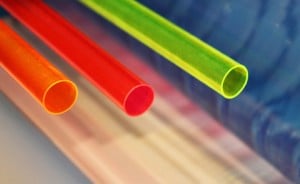
PVC as a technical material: properties, advantages and industrial applications
PVC (Polyvinyl Chloride) is one of the most widely used thermoplastic polymers in the industrial world. Its versatility, durability and mechanical performance make it a key material for manufacturing technical tubes, profiles, mandrels and protective sheaths. Available in both rigid and flexible versions, PVC meets the requirements of various sectors such as construction, automotive, signage, packaging and medical.